Teaching kids about the Qur'an: love, reading and hifz
How to teach children about the Qur'an: what it is, how to handle it, learning to read, memorising short surahs and building a daily habit they'll love.
4 minute read · SunnahPanda

The Qur'an is the word of Allah, revealed to the Prophet Muhammad ﷺ over about 23 years through the angel Jibril. It has 114 surahs and is divided into 30 parts, called juz'. For children, the most important thing isn't how much they memorise early on. It's that they grow up loving the Qur'an and seeing it as a living part of family life.
The best of you are those who learn the Qur'an and teach it.
Start with love, not pressure
- Let them hear it: play recitation in the car, at breakfast or at bedtime from babyhood.
- Let them see you read it. Children copy what they see far more than what they're told.
- Tell the stories in it: Nuh and the ark, Yusuf and his brothers, Musa and the sea, the People of the Cave.
- Connect it to life: when something good happens, share a verse about gratitude; when someone is sad, a verse about Allah's mercy.
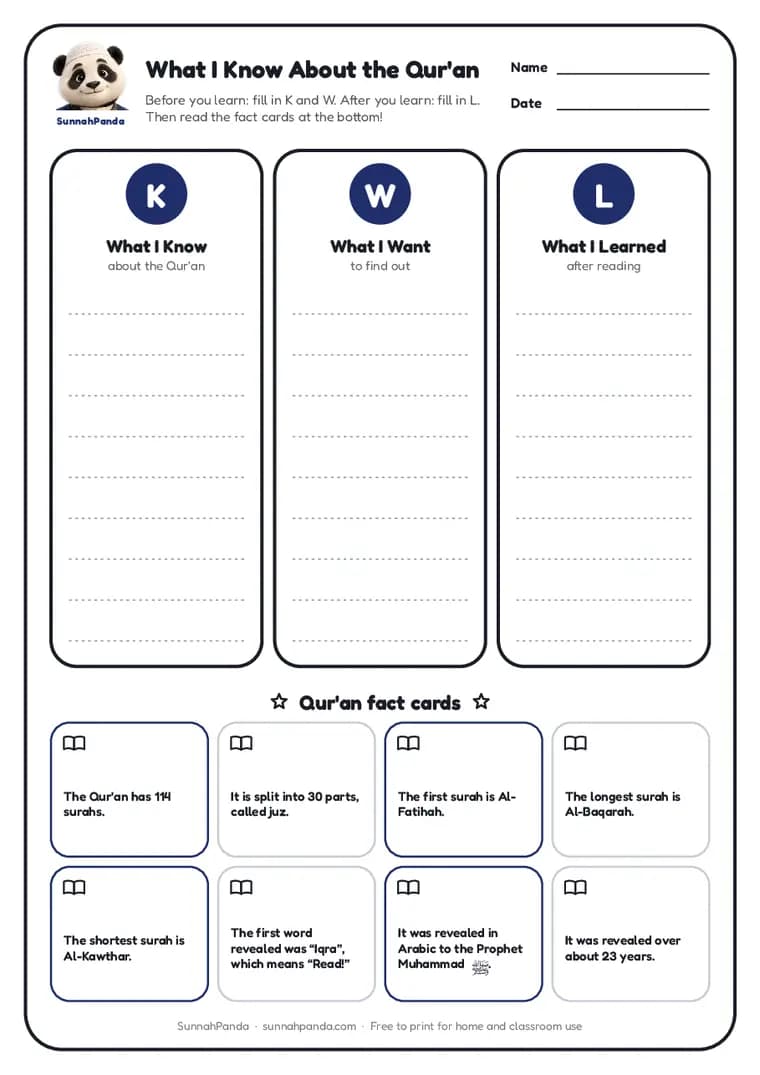
What I Know About the Qur'an
What do your children already know about the Qur'an, and what would they like to find out? A Know, Want to know, Learned chart with fact cards to get them talking.
Read in the name of your Lord who created.
These were the first words of the Qur'an revealed to the Prophet ﷺ. It's a lovely verse to share with children who are learning to read: the very first command was to read.
Respecting the mushaf
Teach children that the Qur'an is special and we treat it with care: keep it on a high shelf, don't put things on top of it, hold it with clean hands and don't take it into the toilet. Whether you need wudu to touch the Arabic mushaf, and how this applies to children who are learning, is something the schools discuss in detail. Many teachers allow young learners more ease, so ask your local imam or madrasah what they advise.
Learning to read
- 1
The Arabic letters
Start with the alphabet: the letter names, sounds and shapes. Little and often works best.
- 2
Vowels and joining
Move on to the short vowels and joined letters with a Qa'idah or similar beginner's book.
- 3
Short surahs from the mushaf
Begin reading from Juz' 'Amma, the 30th part, where the surahs are short and familiar.
- 4
Tajwid
As reading improves, a teacher can introduce the rules of beautiful recitation, one at a time.
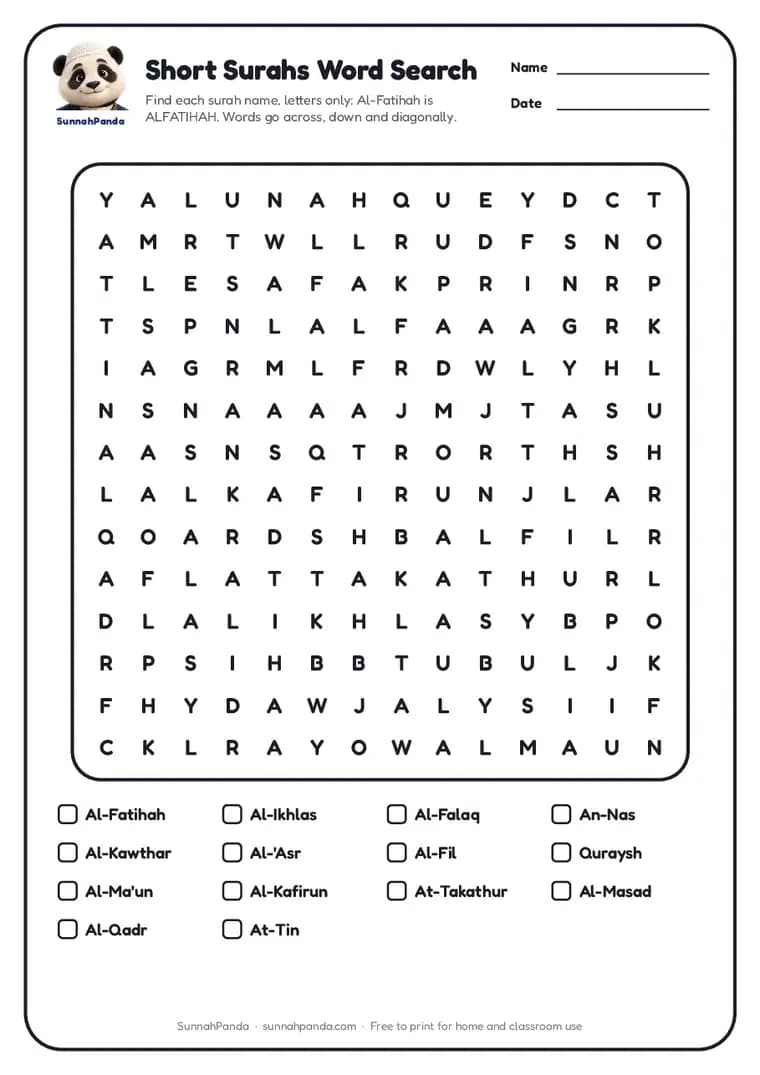
Short Surahs Word Search
Find the names of fourteen short surahs, from al-Fatihah and al-Ikhlas to an-Nas and al-Kawthar. A fun check for children working through Juz' 'Amma.
Memorising short surahs
- 1
Start with al-Fatihah
It's recited in every rak'ah of prayer, so it's the most useful surah to learn first.
- 2
Then the short ones
Al-Ikhlas, al-Falaq and an-Nas are next for most children, then al-Kawthar, al-'Asr and the rest of the last juz'.
- 3
One line at a time
Listen to the line several times, repeat it, then add the next line. Join them up at the end of the week.
- 4
Use them in salah
Encourage your child to recite their newest surah in prayer. Using it keeps it fresh.
- 5
Revise, revise, revise
Keep a list of surahs learnt and revise one old one for every new one.
For more knowledge
Qur'an, Surah Ta-Ha 20:114رَبِّ زِدْنِي عِلْمًا
Rabbi zidni 'ilma
“My Lord, increase me in knowledge.”
Tips for different ages
- Under 4: listening, stories and short phrases like Bismillah. Toddlers absorb far more than you'd think.
- Ages 4 to 7: Arabic letters, al-Fatihah and the three Quls. Five to ten minutes a day is plenty.
- Ages 7 to 12: reading from the mushaf, a regular class or teacher, and a daily Qur'an time of fifteen to twenty minutes.
- Any age: praise effort, not speed. A child who loves the Qur'an at twelve will learn more over a lifetime than one who was pushed and gave up.

SunnahPanda tip
Fix a Qur'an time to something that already happens every day, like straight after Maghrib or after breakfast. Habits tied to existing routines are the ones that last.
Choosing a teacher
If you're looking for a Qur'an teacher, ask other parents for recommendations, sit in on a lesson, and make sure the class follows proper safeguarding. A kind, patient teacher matters more than a fast one.
 End of guide