How to teach kids the salah positions step by step
Teach children the positions of salah one at a time, from standing to sujud, with what to say in each, practice games and tips for every age.
4 minute read · SunnahPanda

Before children can pray confidently, they need to know the shape of the prayer: when to stand, bow, prostrate and sit. The Prophet ﷺ taught his Companions by showing them, and said: "Pray as you have seen me praying" (Sahih al-Bukhari 631). That's the best method for children too. Pray where they can see you, and let them copy.
Teach the movements first and the words second. Once the body knows the order, the words slot in much more easily.
The positions, one at a time
- 1
Qiyam: standing
Stand straight, facing the qiblah, looking at the place where your head will go down. Raise the hands and say "Allahu Akbar" to begin. Then recite Surah al-Fatihah and, in the first two rak'ahs, another short surah.
- 2
Ruku': bowing
Say "Allahu Akbar" and bow, with hands on the knees and back flat. Say "Subhana Rabbiyal-'Azim" (Glory be to my Lord, the Most Great), usually three times.
- 3
Standing up again
Rise saying "Sami'Allahu liman hamidah" (Allah hears the one who praises Him), then "Rabbana wa lakal-hamd" (Our Lord, all praise is Yours). Stand still for a moment.
- 4
Sujud: prostration
Say "Allahu Akbar" and go down with forehead and nose, both hands, both knees and toes on the floor. Say "Subhana Rabbiyal-A'la" (Glory be to my Lord, the Most High), usually three times.
- 5
Sitting between the sujud
Sit up saying "Allahu Akbar", rest briefly, then go down into a second sujud. That completes one rak'ah.
- 6
Tashahhud: sitting
After every second rak'ah, sit and recite the tashahhud. In the last sitting, add the salawat on the Prophet ﷺ.
- 7
Salam: finishing
Turn the head to the right and then to the left, saying "Assalamu 'alaykum wa rahmatullah" each time.
Small differences between schools
Where the hands are placed when standing, whether the hands are raised at ruku', how you sit in the tashahhud and some other details differ between the four schools, and all are based on evidence. Teach your child the way your family and local masjid pray, and if they notice someone praying differently, explain that this is normal. Your imam or madrasah teacher can show the details for your school.

SunnahPanda tip
For sujud, teach the "seven parts" as a counting game: forehead and nose, two hands, two knees, two feet. Touch each one as you count.
Practice games
- Simon says salah: call out "Ruku'!", "Sujud!", "Stand!" and see who gets the right position. Keep this game for practice time, not during an actual prayer.
- Photo sequence: take photos of a parent or older sibling in each position, print them and let your child put them in order.
- Teacher swap: your child shows a teddy how to pray, explaining each step.
- Mirror game: stand side by side in front of a mirror and check that backs are flat in ruku'.
- Count the rak'ahs: lay small stones or buttons and move one across after each rak'ah.
Tips for different ages
- Ages 3 to 5: just the movements and "Allahu Akbar". Let them pray beside you as often as they like, even if they wander off.
- Ages 5 to 7: add the words for ruku' and sujud, al-Fatihah and one short surah, a line at a time.
- Ages 7 to 10: the full prayer, including the tashahhud, and how many rak'ahs each prayer has.
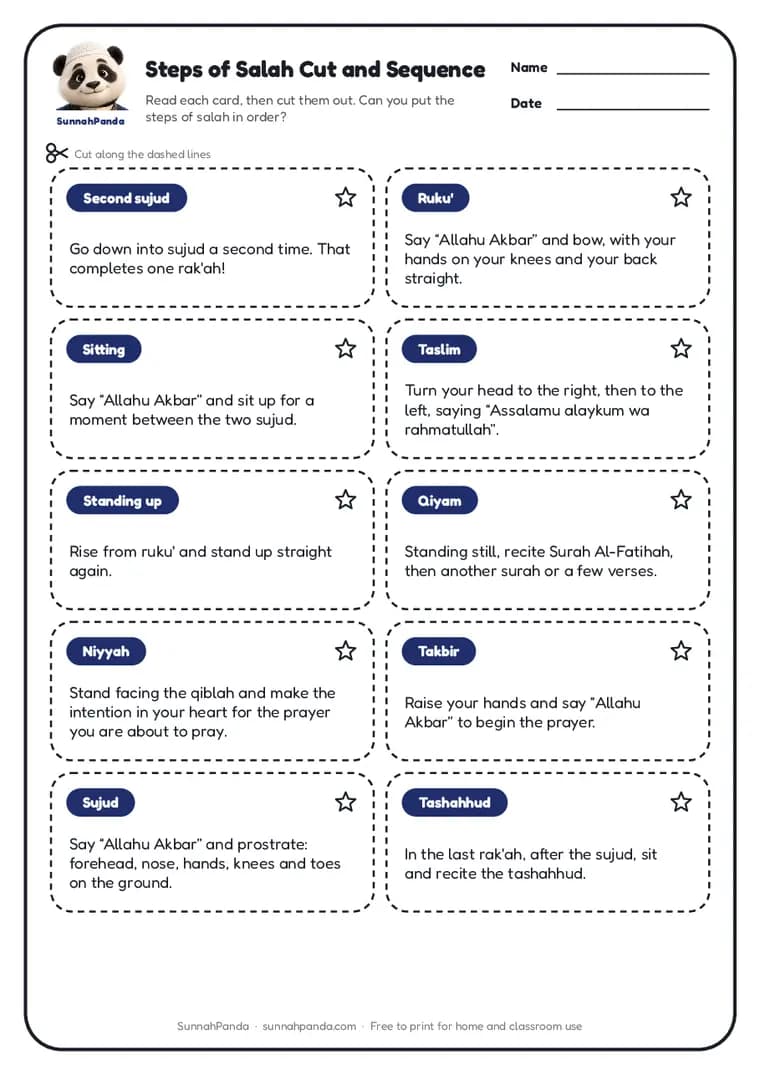
Steps of Salah Cut and Sequence
Cut-out cards for each step of the prayer, from the intention to the salam. Read them, shuffle them and glue them back in order.
When they're ready
Once your child knows the positions and the main words, start with one prayer a day together, then build up. The guide to teaching your child to pray has a gentle path for that, and a tracker on the fridge helps them see their progress.
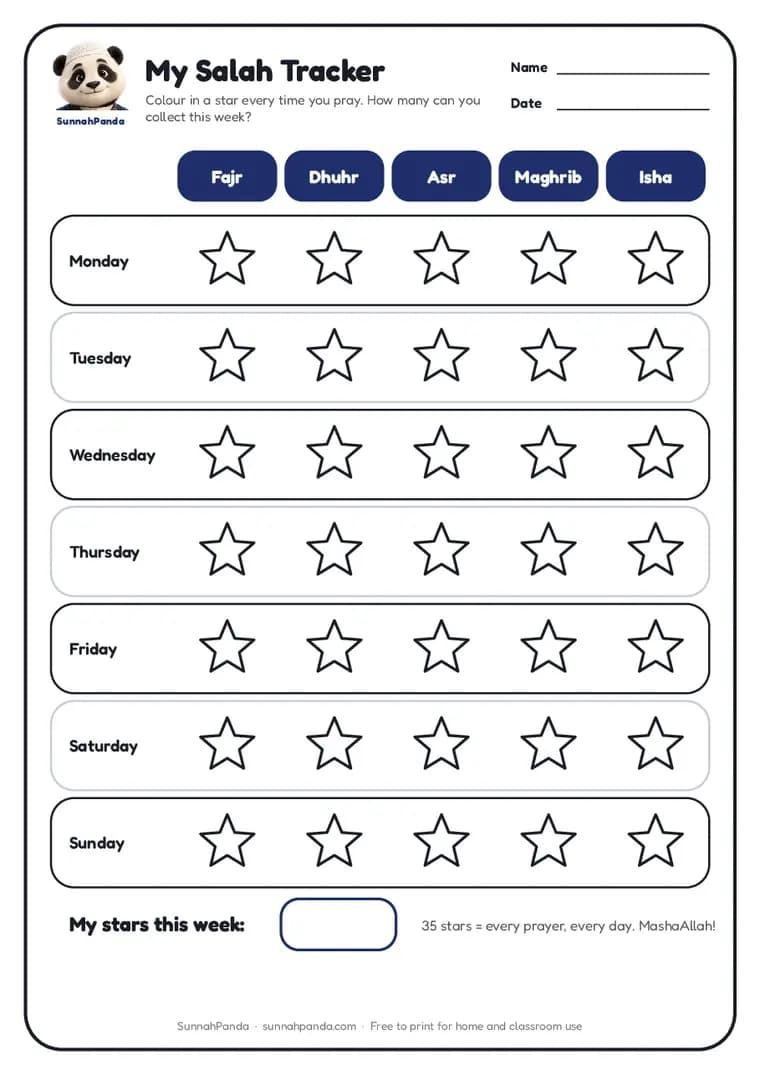
My Salah Tracker
Colour in a star for every prayer. A simple way to celebrate the step from practising positions to praying for real.
 End of guide