How to teach kids the Arabic alphabet at home
A calm, step-by-step way to teach the 28 Arabic letters at home, with games, letter families and tips for toddlers through to age ten.
4 minute read · SunnahPanda

The Arabic alphabet is the doorway to reading the Qur'an, and the good news is that it is very learnable. There are 28 letters, Arabic is read from right to left, and many letters share the same basic shape with dots added above or below. Once children spot those patterns, it starts to feel like a puzzle rather than a wall of squiggles.
You don't need to speak Arabic to start. Plenty of parents learn the letters alongside their children, and that can be a real encouragement: your child sees you learning too.
Before you start
- Keep sessions short: five to ten minutes for under-fives, fifteen to twenty for older children.
- Aim for little and often. Four short sessions a week beats one long one on Saturday.
- Use a good audio source or a teacher to check pronunciation. Some sounds, like ع ('ayn) and ح (ha), have no English match.
- Say "Rabbi zidni 'ilma" together before each session, so learning starts with a du'a.
For more knowledge
Qur'an, Surah Ta-Ha 20:114رَبِّ زِدْنِي عِلْمًا
Rabbi zidni 'ilma
“My Lord, increase me in knowledge.”
A step-by-step path
- 1
Listen and sing
Start with sound, not writing. Play an Arabic alphabet song in the car or at bathtime until the order of the letters feels familiar.
- 2
Meet the letters a few at a time
Introduce two or three letters a week. Say the name, say the sound, and find the letter on a poster or in a Qur'an reader such as a Qa'idah.
- 3
Group the letter families
Teach ب ت ث together: same boat shape, different dots. Then ج ح خ, then د ذ, ر ز, س ش, ص ض, ط ظ, ع غ. Children love spotting the "twins" and "triplets".
- 4
Trace, then write
Trace each letter with a finger in the air, in sand or on a steamy window, then on paper. Remember to start from the right.
- 5
Learn the short vowels
Once most letters are known, add fathah, kasrah and dammah, the little marks that turn ب into ba, bi and bu. This is where reading begins.
- 6
Joining letters
Show how letters change shape at the start, middle and end of a word. Begin with short, real words such as قلم (qalam, pen).
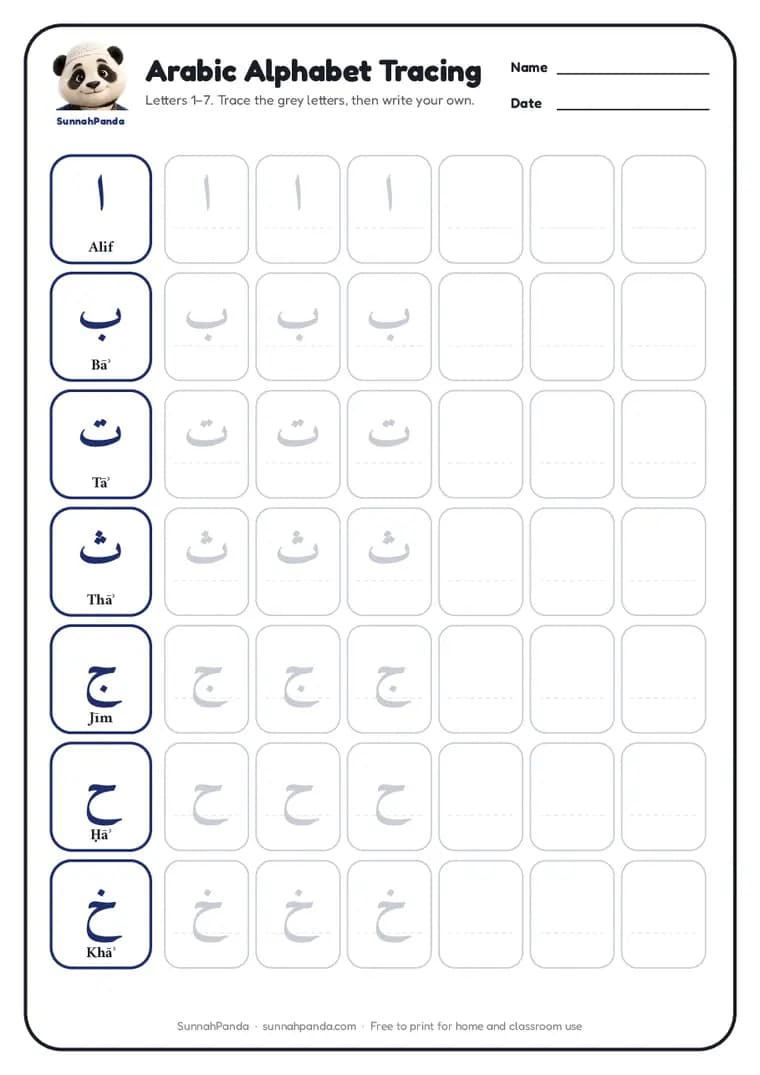
Arabic Alphabet Tracing
All 28 letters with arrows showing where to start, plus space to practise each one. Laminate it and use a dry-wipe pen for endless goes.
Tips for different ages
- Ages 2 to 4: focus on hearing and seeing. Magnetic letters on the fridge, a letter of the week, and lots of praise for pointing to the right one.
- Ages 4 to 6: add tracing and simple matching games. A single-letter tracing sheet for the letter of the week works well. Hide letter cards around the room and ask them to bring back "the one with three dots on top".
- Ages 7 to 10: move on to vowels and joining. A few minutes of reading from a Qa'idah each day builds real fluency.
- Children with dyslexia or who find letters tricky: use bigger letters, multi-sensory tracing (play dough, sand trays) and fewer letters at once.
Games that make it stick
- 1
Letter hunt
Look for Arabic letters on food packets, masjid signs or the cover of a book. Each one found earns a sticker.
- 2
Dot detective
Show a letter shape with the dots covered. Can they guess which letters it might be?
- 3
Swap the teacher
Let your child teach you a letter. Explaining it out loud is one of the best ways to remember.
- 4
Snap and pairs
Make two sets of letter cards and play snap or a memory game. For a bonus round, try the Arabic numbers 0 to 10 too.
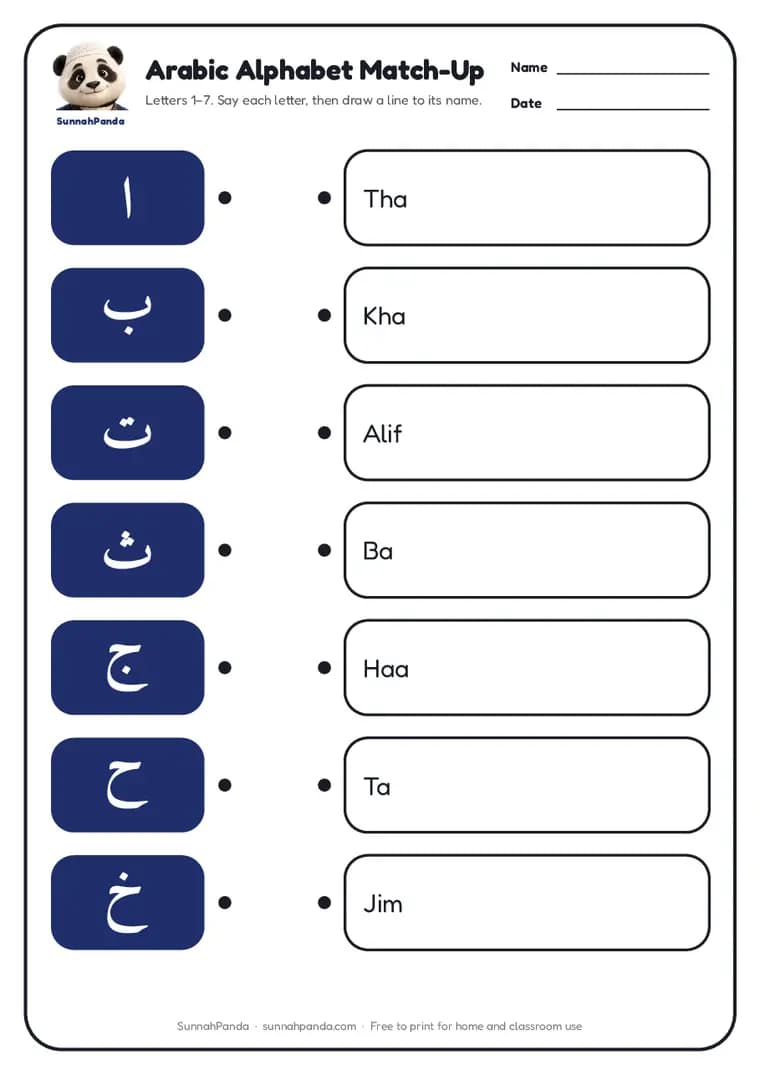
Arabic Alphabet Match-Up
Match each Arabic letter to its name, seven letters a page, all the way from alif to ya. A quick check of which letters have really stuck.

SunnahPanda tip
Keep a small "letters I know" chart and add each new letter as it's mastered. Seeing the row grow week by week is hugely motivating.
Pronunciation and tajwid
Letter names and the finer points of pronunciation are taught slightly differently from one teacher or Qa'idah to another. That's normal. If your child also attends a madrasah, follow the method their teacher uses so they aren't learning two systems at once.
 End of guide