The Islamic months for kids: names, order and meaning
Teach children the 12 Islamic months in order, why the dates move each year, the four sacred months and the special days to look out for.
4 minute read · SunnahPanda

Muslims use a calendar based on the moon, called the Hijri calendar. Each month begins when the new crescent moon is seen, and there are twelve months in the year. Learning them helps children understand why Ramadan and Eid arrive at a different time every year, and it gives them a sense of the rhythm of the Muslim year.
Indeed, the number of months with Allah is twelve months in the register of Allah, from the day He created the heavens and the earth; of these, four are sacred.
The twelve months in order
- 1
Muharram
The first month and one of the four sacred months. The 10th is the Day of 'Ashura.
- 2
Safar
The second month.
- 3
Rabi' al-Awwal
The third month, in which many historians say the Prophet ﷺ was born.
- 4
Rabi' ath-Thani
The fourth month, also called Rabi' al-Akhir.
- 5
Jumada al-Ula
The fifth month.
- 6
Jumada al-Akhirah
The sixth month, also called Jumada ath-Thaniyah.
- 7
Rajab
The seventh month and one of the four sacred months.
- 8
Sha'ban
The eighth month, the month before Ramadan, a good time to get ready.
- 9
Ramadan
The ninth month, the month of fasting, when the Qur'an was first revealed.
- 10
Shawwal
The tenth month. It starts with Eid ul-Fitr.
- 11
Dhul Qa'dah
The eleventh month and one of the four sacred months.
- 12
Dhul Hijjah
The twelfth month, a sacred month: the month of Hajj and Eid al-Adha.
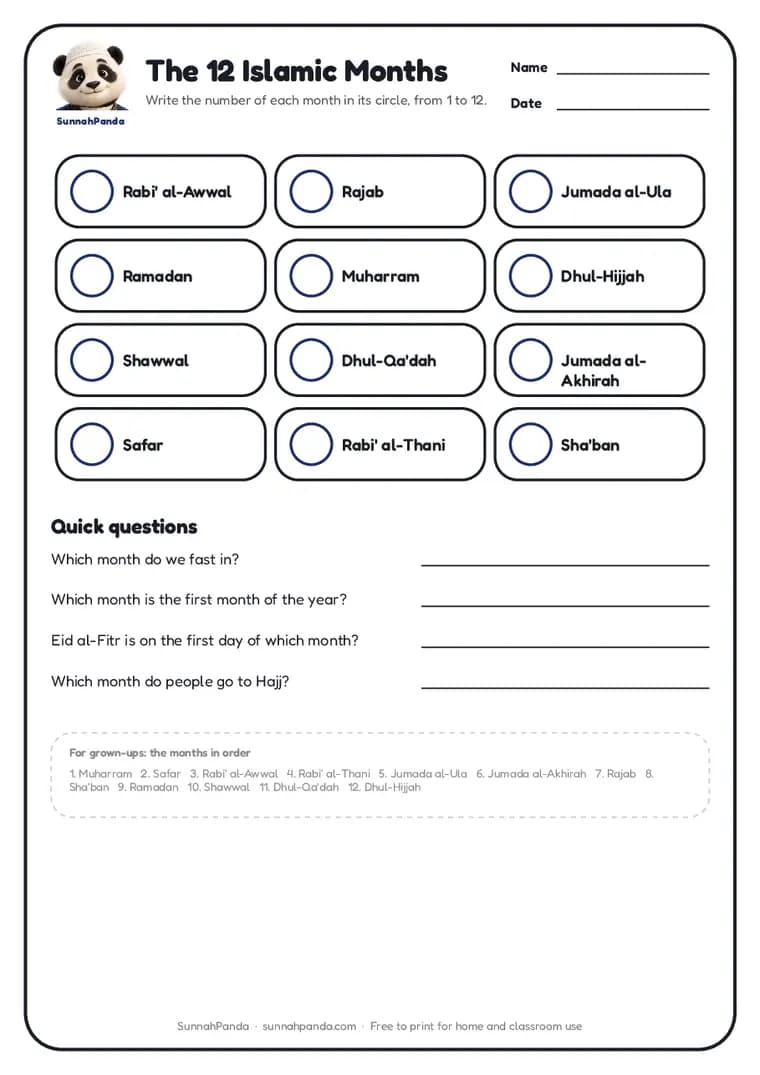
The 12 Islamic Months
All twelve months to cut, colour and put in order. Stick the finished chart on the wall and move a paper moon along it each month.
Why do the dates move?
A month on the moon calendar is 29 or 30 days long, so the Islamic year is about 354 days, roughly eleven days shorter than the usual calendar year. That's why Ramadan comes around eleven days earlier each year. Over about 33 years, it moves through every season. Older children love working out which season Ramadan will be in when they're grown up.
Moon sighting and calculation
Communities differ on how they start a new month: some wait to see the moon locally, some follow sightings from another country, and some use astronomical calculation. That's why neighbouring masjids sometimes start Ramadan or celebrate Eid on different days. Follow your local masjid, and explain to children that sincere scholars have different views on this.
Special days to look out for
- 10 Muharram, 'Ashura: the Prophet ﷺ fasted on this day and encouraged it. Many also fast the 9th alongside it.
- Ramadan: the whole month of fasting, with Laylat al-Qadr in its last ten nights.
- 1 Shawwal: Eid ul-Fitr.
- First ten days of Dhul Hijjah: the best days of the year for good deeds.
- 9 Dhul Hijjah: the Day of Arafah.
- 10 Dhul Hijjah: Eid al-Adha.
Ways to learn them
- 1
Moon spotting
Go outside on the evening a new month is expected and look for the thin crescent low in the west after sunset. Keep a moon diary for a month and draw its shape each night.
- 2
Sing the months
Put the twelve names to a tune your child already knows. Repeating them in order in the car works wonders.
- 3
Today's date
Each morning, say the Islamic date as well as the usual one. Many prayer timetables and apps show both.
- 4
Birthday in Hijri
Look up which Islamic month your child was born in. It makes the calendar feel personal.
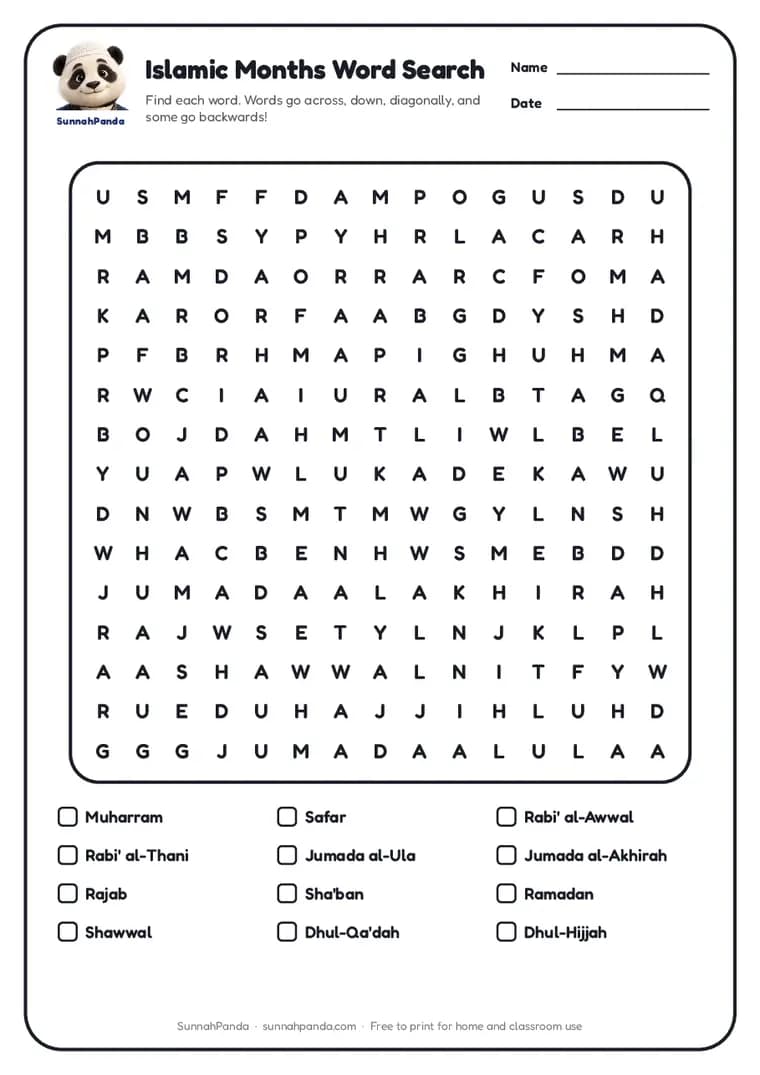
Islamic Months Word Search
A tricky search for all twelve Hijri months, for older children who already know the names. Answers included.
Ideas by age
- Under 5: just Ramadan, Eid and watching the moon change shape.
- Ages 5 to 8: the twelve names in order, plus which months have the big days.
- Ages 9 and up: why the year is shorter, the four sacred months, and converting dates between the two calendars.

SunnahPanda tip
Hang a simple Islamic calendar by the fridge and let a different child turn the page each new month. It's a small job that keeps the calendar in everyone's mind.
 End of guide