How to explain Hajj to kids, step by step
Explain Hajj to children simply: the story of Ibrahim, Hajar and Isma'il, what pilgrims do each day, and hands-on ideas to bring the journey home.
5 minute read · SunnahPanda

Hajj is the fifth pillar of Islam: a journey to Makkah that every adult Muslim should make once in their life, if they are healthy enough and can afford it. Every year, millions of people from every country gather in the same place, dressed in simple white, to worship Allah together. For children, it's a wonderful story to tell, because so much of it goes back to one family who trusted Allah completely.
And pilgrimage to the House is a duty owed to Allah by people who are able to find a way there.
Start with the story
Hajj makes most sense when children know the story behind it. Long ago, the Prophet Ibrahim (peace be upon him) left his wife Hajar and their baby son Isma'il in a dry valley in Makkah, as Allah had commanded. When their water ran out, Hajar ran back and forth between two small hills, Safa and Marwah, looking for help. Allah sent the water of Zamzam, which still flows today. Later, Ibrahim and Isma'il built the Ka'bah together as a house for the worship of Allah.
And when Ibrahim was raising the foundations of the House, and Isma'il, [they said]: Our Lord, accept this from us.

SunnahPanda tip
When you tell stories of the prophets, keep the focus on what they did and why. We don't draw prophets or describe what they looked like, so use pictures of places, like the Ka'bah or the hills of Safa and Marwah, instead.
What pilgrims do, in order
- 1
Ihram
Pilgrims make their intention and enter a special state called ihram. Men wear two plain white cloths; women wear simple, modest clothes. Everyone looks alike, rich or poor.
- 2
Talbiyah
All the way, pilgrims call out: "Labbayk Allahumma labbayk", which means "Here I am, O Allah, here I am".
- 3
Tawaf
Walking seven times around the Ka'bah, anticlockwise, remembering Allah.
- 4
Sa'i
Walking seven times between Safa and Marwah, just as Hajar did when she searched for water.
- 5
Mina and Arafah
Pilgrims stay in tents at Mina, then on the 9th of Dhul Hijjah stand on the plain of Arafah, making du'a from midday until sunset. This is the heart of Hajj.
- 6
Muzdalifah
They spend the night under the open sky at Muzdalifah and collect small pebbles.
- 7
Stoning the pillars
Back in Mina, pilgrims throw pebbles at stone pillars, a reminder to reject Shaytan's whispers, as Ibrahim did.
- 8
Sacrifice, haircut and Eid
An animal is sacrificed, men shave or shorten their hair, and it's Eid al-Adha. Muslims all over the world celebrate with them.
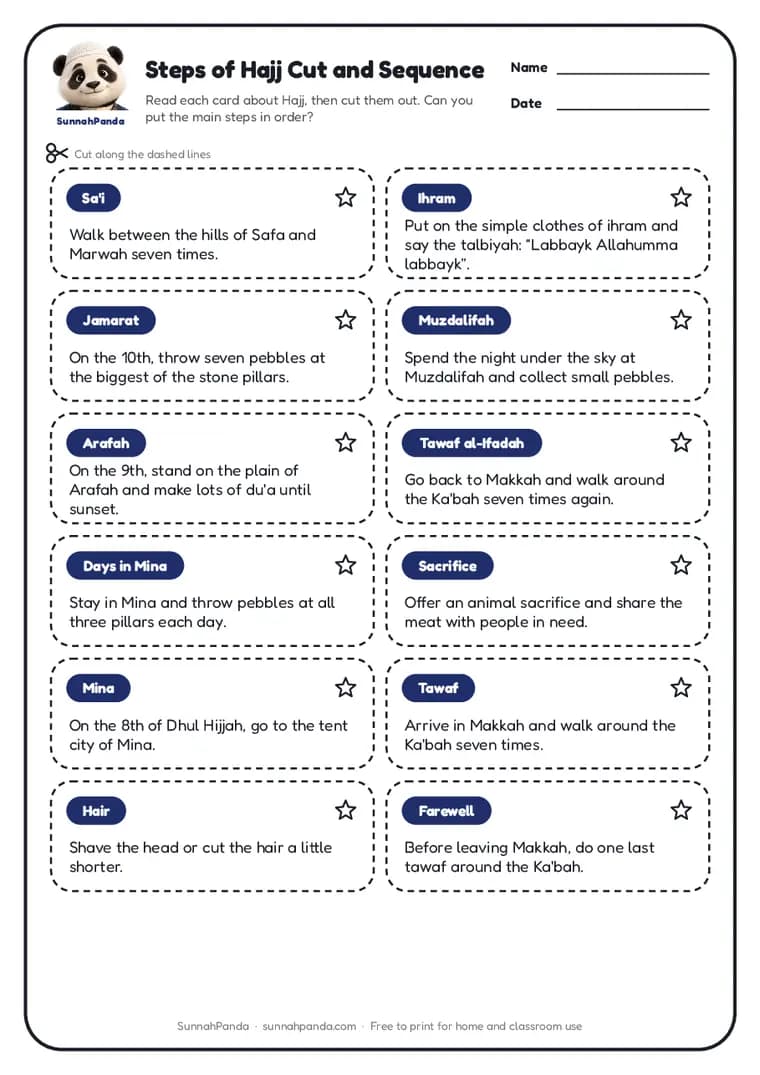
Steps of Hajj Cut and Sequence
Twelve cards for the main rites of Hajj, from ihram and tawaf to Arafah and Muzdalifah. Read them together, cut them out and glue them in order.
Keeping it simple
Scholars describe the exact order of some rites, and which ones are pillars or obligations, slightly differently, and there are three ways of performing Hajj. For children, the outline above is enough. If an older child wants the detail, a local imam or teacher can explain how your school sets it out.
Bring Hajj home
- Build a model Ka'bah from a cardboard box covered in black paper, and walk seven times around it with toys or figures.
- Lay two cushions at either end of the hallway for Safa and Marwah and walk between them seven times.
- Find Makkah on a world map, then find where you live. How would you travel there?
- Learn the talbiyah together and say it on the way to school during Dhul Hijjah.
- Ask a grandparent, aunt or neighbour who has been on Hajj to tell your children about it.
Ideas by age
- Under 5: the story of Hajar and the water of Zamzam is enough. Act out the walking between the cushions.
- Ages 5 to 8: add the main steps above, using the model Ka'bah and a picture timeline on the wall.
- Ages 9 and up: talk about why Hajj matters. Everyone dressed the same, all languages and colours together, and the meaning of each rite.
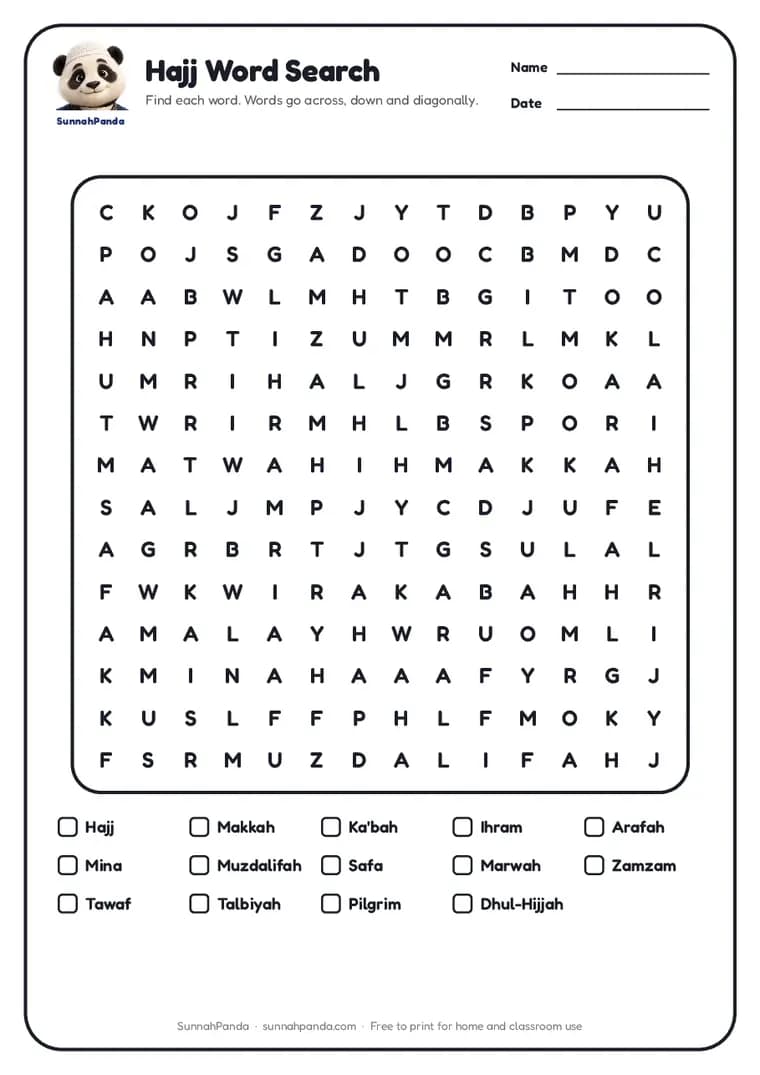
Hajj Word Search
Find Ihram, Arafah, Muzdalifah, Zamzam, Tawaf and more. A good way for older children to learn the names of the places and rites.
SunnahPanda tip
The first ten days of Dhul Hijjah, while Hajj is happening, are the perfect time to tell this story. Read a little each evening and finish on the Day of Arafah.
 End of guide